The first step in respecting language is keeping it as concrete, meaningful, and truthful as possible—part of the job of keeping information streams clear. The second step is to enlarge language to make it consistent with our enlarged understanding of systems.
Our culture, obsessed with numbers, has given us the idea that what we can measure is more important than what we can’t measure.
Be a quality detector. Be a walking, noisy Geiger counter that registers the presence or absence of quality.
If something is ugly, say so. If it is tacky, inappropriate, out of proportion, unsustainable, morally degrading, ecologically impoverishing, or humanly demeaning, don’t let it pass. Don’t be stopped by the “if you can’t define it and measure it, I don’t have to pay attention to it” ploy. No one can define or measure justice, democracy, security, freedom, truth, or love. No one can define or measure any value. But if no one speaks up for them, if systems aren’t designed to produce them, if we don’t speak about them and point toward their presence or absence, they will cease to exist.
SE Portland to Boring, OR and back. March 18, 2017.
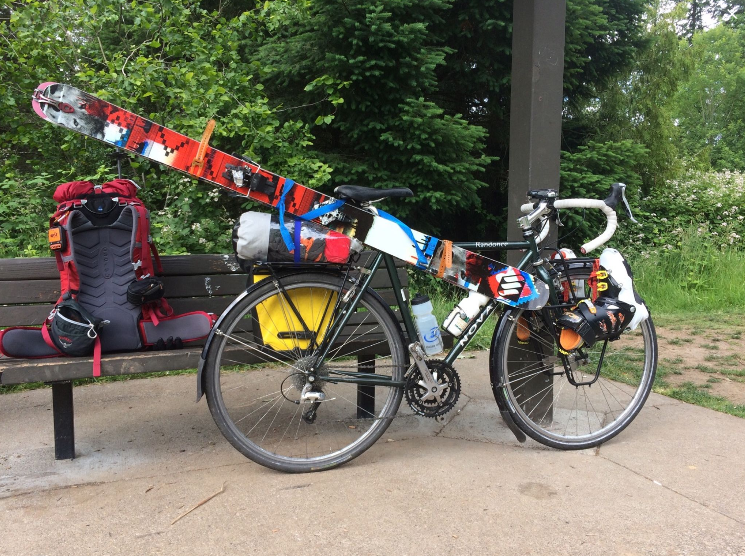
I rode out to the intersection of 212 and 26 today, mostly to get some miles in, but also to start prepping for my 2nd attempt at a human powered climb of Hood from Portland. The plan is to ride to Timberline, skin up to Hogsback, summit and then ski back to my bike (and ride back to Portland). Boom boom boom.
That was my plan last year. Lots of things went wrong, but the biggest was simply leaving too late in the afternoon. I was packing and repacking and left the house mid-afternoon with my skis on my pack (on my back) which proved unsustainable after 5 miles, so I had to stop and readjust – the first of 3 times trying to find a comfortable way to carry the skis on the bike for 64 miles (I only made it 56 miles before pulling the plug at the rest area in Government Camp).
SE Portland to Government Camp, by bike.
Things I’m thinking about this year:
Maybe have someone meet me at Timberline to help me get some food and warm up and mainly watch the bikes. I’m not sure I feel comfortable locking the bike up — and I don’t really want to carry a lock all the way up there anyway. Last year my plan was at arrive before sunset, cook some food, change and take a power nap before starting to climb – I never made it that far.
If I leave earlier in the morning and take the day to ride out, I can be more relaxed about a start time and getting some rest, recovering from the ride.
I don’t want a sag wagon or assistance, but maybe just someone to help out with transitions. TBD to carry bivy gear and a bag to sleep…. more weight == less likely to finish… the light and fast or margin of error debate. ¯_(ツ)_/¯
There was a lot of construction on 26 last year between Welches and Govy. All that construction is done and there’s a nice wide shoulder now. The only close call I had was after dark just before I got to the Ski Bowl parking lot – a big semi rolled by and the wind blast started to pull me left – I steered hard right and hit the guardrail and banged up my knee. That’s when I stopped and took stock of everything for a minute or two.
Too much stuff. I took my big belay parka to use as a bivy/sleeping bag and I had my jetboil to cook some hot food… but I never got to that point.
I was looking through my training log leading up to the attempt last year and I was only averaging about 40 miles of riding in the weeks leading up to the “BIG RIDE”. I’m taking some time from running right now and I’ve averaged about 100 miles a week for the last few weeks. I think I’ll be in much better cycling shape for this attempt.
In Bruce Chatwin’s book The Songlines, he writes about Australian Aborigines singing their world into existence:
A knowledgeable person is able to navigate across the land by repeating the words of the song, which describe the location of landmarks, waterholes, and other natural phenomena. In some cases, the paths of the creator-beings are said to be evident from their marks, or petrosomatoglyphs, on the land, such as large depressions in the land which are said to be their footprints.
I just love the idea of human powered adventures. I’ve been thinking of a way to push the boundaries of what’s possible – and I’ve come up with a new twist.
Instead of heading home after climbing Hood, my plan is to hang a left on 26 to 35, ride down to Hood River, cross the bridge to White Salmon, and then ride out to Trout Lake and climb and ski Mt. Adams. Then riding to St Helens to climb it and then riding back home again.
Cycling mileage looks something like:
64 miles to Timberline
90 miles to Mt Adams
90 miles to St. Helens
80 miles to home
~325 miles?
So.. some logistical concerns that I’m mulling:
I’ll need bivy gear to sleep, this isn’t a one shot deal but a multi-day suffer-fest
I’ll need a lot of food, on the bike, climbing and dinner fuel
I’m leaning away from pulling a trailer – I think it would just kind of suck … but not out of the question yet. I need a better way to carry my skis.
How many days?
Where to bivy? There will be some recovery time at Timberline before climbing … so in the parking lot. Then maybe somewhere closer to Adams. Could be a big day of riding to get ready for Adams the next day. Then somewhere on the way to St. Helens.. not sure – I can’t see this far ahead for this adventure. The day between Adams and St Helens could be a real treat.
Getting across the bridge to White Salmon – bikes aren’t allowed on the bridge, but I’ve heard you can get a shuttle.. or have someone transport me over the bridge.
When is the road to Morrison Creek going to be snow free enough to ride it to the Adams trailhead? Route timing in general.
That’s it for now…
Why do anything really? In this case.. because it makes me happy.
I’ve been taking the long commute on my bike the last couple of weeks as I take a short break from running. I’m riding further East toward the freeways and then taking the commuter/walking path in a big loop back to the Willamette River and into downtown. It’s about 17 miles, mostly flat and fast if you want to drop the hammer (when you’re a hammer, everything is a nail – an adage I thought of as I was trying to maintain 20mph + on my commute and sweating profusely in a driving rain).
There has been a lot of controversy about the homeless in Portland and recently (last Fall) there was a effort by the city to break up homeless camps along the Springwater corridor.
Well… it turns out most of those structures decamped East onto the 205 path where they’re now firmly established between the path and freeway boundary wall. On the West side of the 205 path is a neighborhood, and in one of those neighborhoods is a front yard garden….errr, the kind of garden created with “found objects”. The objects in this case are bicycle wheels (sans tires), sheet metal formed into flowers 5 feet in diameter, pots of dead flowers, and an excavated (and empty) koi pond all of which is surrounded by a 4 foot tall chain link fence.
The pièce de résistance of this garden is a spray painted white bicycle frame, fork and handlebar situated in the center of the yard.
I’ve stopped twice on different days to take pictures with my phone of this garden, but when looking at them when I get into the office, they just don’t seem that interesting. The bicycle frame, fork and handlebars with the tireless wheels mounted on the bird bath is my favorite piece and yet when I snap it – I inadvertently get the late 90’s Honda parked in the driveway – and it immediately looks less than artistic.
And the idea that I can’t seem to shake is that my interpretation of this found object garden and the artistic merits of the bicycle frame, fork and handlebar will in no way be distinguished from Pablo Picasso’s Bull’s Head. Though the artist’s intent was the same, one is a junk garden and one is “astonishingly complete” metamorphosis. Furthermore, these two pieces of found object art will be indistinguishable in importance by a neural net.
The same way that a child cannot yet process irony or sarcasm, a deep learning algorithm will not be able to make nuanced interpretations of art.
As I slid my phone back into my pocket, heaved my backpack onto my shoulders and clipped into my pedals, I had the distinct feeling that our future robot utopia is going to be decidedly less… fun.
This book has been sitting on my shelf for about 10 years. I finally decided to pick it up and read it. The Shock Doctrine by Naomi Klein.
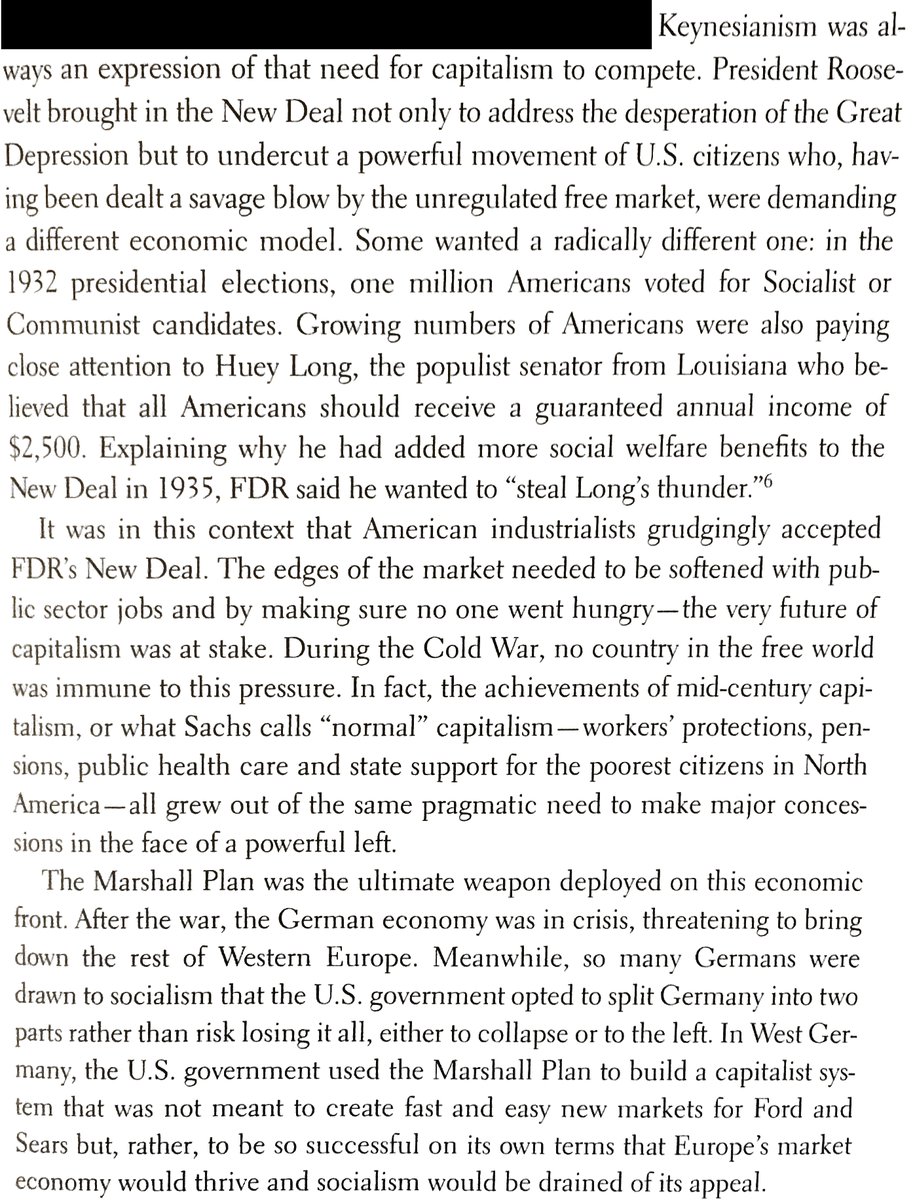
Beginning in the 1970’s in Latin America, Neoliberals from the Chicago School of Economics, following the ideology of Milton Friedman and Friedrich Hayek began to influence (experiment with) the economies of countries in the Southern Cone. Chile, Argentina, Brazil, Bolivia.
The three pillars of Friedman’s Neoliberalism:
Privatization: Open up all state owned businesses to multinational corporations
Deregulation: Remove laws that protect the state from multinationals operating within the country
Free Trade: No laws to impinge upon quotas, imports or exports
These concepts are in stark contrast to developmentalism and the ideas of John Maynard Keynes. Keynesian economic theory is best captured in the policy of The New Deal under Roosevelt (in the U.S.). And more recently in the government spending that brought the country back from the Great Recession in 2009-2009. The government is spending capital to build social programs and spur economic growth. It worked during the New Deal and it worked under the Obama administration.
Klein’s premise is that free market capitalism based on Neoliberalism is incompatible with democracy. It is based on the concept of a clean slate – in the context of a nation state, it means that the existing economy and political landscape is wiped clean and new economic policies are introduced. Historically these policies need to be backed up with force – thus the dictatorships in Latin America.
Her theory is that the introduction of these free market policies are best introduced following a shock to the culture where the population is disoriented – and neoliberal policies are instituted upon an unwilling (and uninformed) population. (Remember Shock and Awe in Iraq?). The idea is that the existing order is completely disoriented. Order being the existing political body, the economy, the general population.
She begins the exploration of the parallels between shock therapy on an individual scale with the experiments in the 1960’s in Montreal (funded by the CIA to counter the belief that Cold War spies were being brainwashed). These experiences were effectively torture experiments to determine if a person could be psychologically wiped clean and regress to a infantile state where they can be easily influenced. The output of these experiments led to the creation of the Kubark manual of interrogation. This sound hugely conspiratorial – but Klein does a great job through most of the book in weaving a coherent narrative from the repressive dictatorships of Latin America (Pinochet in Chile) to the fall of the Soviet Union to apartheid in South Africa and the debacle of the United States occupation and failed reconstruction in Iraq.
Neoliberals have been trying to roll back social programs b/c they feel they’re … socialist. There has been a conflation of “freedom” with “free market capitalism”. Free market capitalism is not equally distributed across a population.
laizzez-faire, free market capitalism benefits those in power and leads to vast differences between rich and poor (we’re seeing this in the US right now). The economy of Sweden is the antithesis. Open democracy, capitalism balanced with social programs. This is what’s know as “the middle way”.
the multinational overlap in neoliberalism is a resource grab. All operations of the state should be privatized, multinationals come in and export profits out of the country. Interestingly, Russia did not do this and thus the oligarchs were established after the collapse of the Soviet Union.
The war in Iraq was an abject failure of neoliberal policies, yet no one was held responsible for destroying the country. (I could go deep into the irony of the current administration blaming the former administration to spawning ISIS, but I’ll stop. The destruction of Iraq was primarily an economic failure – that led to a political failure, that led to where we are now.
Economics are directly tied to political changes – they go hand in hand
Many developing countries are wising up to the IMF and World Bank. They are effectively lending mass sums of money to countries in exchange for opening up their markets to deregulation and privatization.
There’s a lot more to the book that what I’ve noted. I found the historical context of the US’s involvement in Latin America fascinating. It also allowed me (in reading the book 10 years later) to form a cohesive timeline of how neoliberalism contributed to the current situation in the middle east. There’s a great chapter toward the end of the book about the homeland security industry and the Israeli technology sector.
I heard the phrase “information pollution” from Evgeny Morozov the other day and I think it perfectly captures what I’ve been thinking as I try to allocate more time to read and write and think during the day. It’s a grasping at the ability to have a cohesive thought, to formulate a thesis and make a case for an idea without being sidetracked and having my attention hijacked.
It fits with the concept of choice architecture and the behavioral underpinnings of an internet supported by advertising.
It’s the long tail, the power law, the Pareto distribution of garbage information to valuable information. Most of what is online, in the explosion of online “news”and social media is of “low value” and doesn’t contribute to a deeper understanding of any complex topic and primarily serves as a distraction to the exercise of thinking deeply about a specific topic.
It’s become more apparent to me as I try to save articles to read in the future (when I have time) and also move deliberately through my book reading list. I’ve been more critical about what I’m spending time reading and I’m finding that articles that initially look interesting are in fact comprised of low value information.
I’ll try to write something longer after I think about this a bit more, but there’s something at the intersection of choice architecture, attentional focus and distraction.
Supervised learning procedures are used in problems for which we
can provide the system with example inputs as well as their corre‐
sponding outputs and wish to induce an implicit approximation of
the rules or function that governs these correlations.
The kinds of problems that can be addressed by supervised learning procedures are generally divided into two categories: classification and regression problems.
In a classification problem, the outputs relate to a set of discrete categories.
For example, we may have an image of a handwritten character and
wish to determine which of 26 possible letters it represents. In a
regression problem, the outputs relate to a real-valued number. For
example, based on a set of financial metrics and past performance
data, we may try to guess the future price of a particular stock.
Unsupervised
Unsupervised learning procedures do not require a set of known out‐
puts. Instead, the machine is tasked with finding internal patterns
within the training examples. Procedures of this kind are “unsuper‐
vised” in the sense that we do not explicitly indicate what the system
should learn about. Instead, we provide a set of training examples
that we believe contains internal patterns and leave it to the system
to discover those patterns on its own.
In general, unsupervised learning can provide assistance in our efforts to understand extremely complex systems whose internal patterns may be too
complex for humans to discover on their own. Unsupervised learn‐
ing can also be used to produce generative models…
Semi-supervised
Semi-supervised learning procedures use the automatic feature dis‐
covery capabilities of unsupervised learning systems to improve the
quality of predictions in a supervised learning problem. Instead of
trying to correlate raw input data with the known outputs, the raw
inputs are first interpreted by an unsupervised system. The unsuper‐
vised system tries to discover internal patterns within the raw input
data, removing some of the noise and helping to bring forward the
most important or indicative features of the data. These distilled ver‐
sions of the data are then handed over to a supervised learning
model, which correlates the distilled inputs with their correspond‐
ing outputs in order to produce a predictive model whose accuracy
is generally far greater than that of a purely supervised learning system.
Reinforcement learning
Reinforcement learning procedures use rewards and punishments to
shape the behavior of a system with respect to one or several specific
goals. Unlike supervised and unsupervised learning systems, rein‐
forcement learning systems are not generally trained on an existent
dataset and instead learn primarily from the feedback they gather
through performing actions and observing the consequences.
I’m a sucker for the larger historical contexts of technology and culture. This book didn’t disappoint. I’m finding these types of books, where the author takes a contemporary idea and does a bunch of research and then writes a book to be less interesting than books with original ideas that are then supported with research. In this light I think Matthew Crawford’s book (The World Beyond your Head) is bit more on point.
The ideas around autonomous vehicles in transportation were interesting – cars and airplanes. This is the hot topic in technology culture right now. I thought the book was weak in the exploration of automation of cognitive work – the medical records and legal professions. This is most likely due to there being a dearth of writing about loss of white collar jobs to automation… from memory I think the trader (human) in the example of electronic trading algorithms was the most interesting. Same concept in a different context (speed) was the example of warfighting. It made me think of an example where there could be a war/conflict between two nation states’ autonomous systems that could occur overnight and the result would be that the losing sides economy collapses the next day and no one would know what happened.
He never mentioned Metropolis for some reason.
I liked focus on ‘generative thinking”. I thought about the distinction between something like a VR environment, immersive and complete (according to the creator) and something like a command line game or even a board game where the environment and immersive aspect need to be filled in by the consumer/player – this is more of a co-creative exercise. This idea can be taken out to really any physical / virtual interaction. It’s the core idea that Carr returns to at the end of the book with a line from Robert Frost’s poem, Mowing:
The fact is the sweetest dream that labor knows.
We rarely look to poetry for instruction anymore, but here we see how a poet’s scrutiny of the world can be more subtle and discerning than a scientist’s. Frost understood the meaning of what we now call “flow” and the essence of what we now call “embodied cognition” long before psychologists and neurobiologists delivered the empirical evidence. His mower is not an airbrushed peasant, a romantic caricature. He’s a farmer, a man doing a hard job on a still, hot summer day. He’s not dreaming of “idle hours” or “easy gold.” His mind is on his work— the bodily rhythm of the cutting, the weight of the tool in his hands, the stalks piling up around him. He’s not seeking some greater truth beyond the work. The work is the truth.
It’s the cognitive work that humans do to fill in the blanks of reality. I think there’s some philisophical underpinning here but I don’t know what it is – maybe William James? or maybe Rihanna. Work work work.
The mental act of generation improves people’s ability to carry out activities that, as education researcher Britte Haugan Cheng has written, “require conceptual reasoning and requisite deeper cognitive processing.”
I think one of his main premises is that embodied cognition is what makes us human and when we relegate tasks to an autonomous system, we become “less human”. I’ve been falling into the cognitive bias lately of gravitating toward every automation news article lately and I’m beginning to see them as overhyped in general. There are definitely concrete economic indicators that automation is replacing many jobs, but I think in general the current frenzy is tapping into the deeply held fear of some kind of Skynet fiction.
Both complacency and bias seem to stem from limitations in our ability to pay attention. Our tendency toward complacency reveals how easily our concentration and awareness can fade when we’re not routinely called on to interact with our surroundings. Our propensity to be biased in evaluating and weighing information shows that our mind’s focus is selective and can easily be skewed by misplaced trust or even the appearance of seemingly helpful prompts. Both complacency and bias tend to become more severe as the quality and reliability of an automated system improve.
There has been quite a bit of discussion about Guaranteed Basic Income as a future possibility of automation. Carr doesn’t seem to think that’s a realistic possibility. I’m less critical. In this aspect, it think there could be market forces to fill the need to idle hours of people with massive amounts of free time. In fact I think there could be a new renaissance in arts and culture – this could be the new work that replaces the hours at a desk or in a factory.
There’s a callousness to such grandiose futurism. As history reminds us, high-flown rhetoric about using technology to liberate workers often masks a contempt for labor. It strains credulity to imagine today’s technology moguls, with their libertarian leanings and impatience with government, agreeing to the kind of vast wealth-redistribution scheme that would be necessary to fund the self-actualizing leisure-time pursuits of the jobless multitudes.
The “choose your own adventure” autonomous future that I found comforting was the idea of adaptive automation:
One of the most intriguing applications of the human-centered approach is adaptive automation. In adaptive systems, the computer is programmed to pay close attention to the person operating it. The division of labor between the software and the human operator is adjusted continually, depending on what’s happening at any given moment. When the computer senses that the operator has to perform a tricky maneuver, for example, it might take over all the other tasks. Freed from distractions, the operator can concentrate her full attention on the critical challenge. Under routine conditions, the computer might shift more tasks over to the operator, increasing her workload to ensure that she maintains her situational awareness and practices her skills. Putting the analytical capabilities of the computer to humanistic use, adaptive automation aims to keep the operator at the peak of the Yerkes-Dodson performance curve, preventing both cognitive overload and cognitive underload. DARPA, the Department of Defense laboratory that spearheaded the creation of the internet, is even working on developing “neuroergonomic” systems that, using various brain and body sensors, can “detect an individual’s cognitive state and then manipulate task parameters to overcome perceptual, attentional, and working memory bottlenecks.”23 Adaptive automation also holds promise for injecting a dose of humanity into the working relationships between people and computers. Some early users of the systems report that they feel as though they’re collaborating with a colleague rather than operating a machine.
I like that he named the last chapter Automation for the People, which I assume is a throwback to Automatic for the People. Probably the best R.E.M. album… and the best song from that album.






 Chris Rivard / Product Designer